

Parking Structure Inspection Requirements Explained
Parking structures are often treated as maintenance-free structures. But in reality, they are exposed to rain, temperature fluctuations, vehicle traffic, deicing salts, and repeated wetting and drying. These conditions can lead to premature concrete deterioration, corrosion of reinforcing steel and structural connections, failed waterproofing systems, and other conditions that may affect public safety and shorten the service life of the structure.
Timely inspections and cost-effective maintenance programs can identify developing problems before they require emergency closures or major structural repairs.
The key point: There is no single federal inspection requirement that applies to every parking structure in the United States. Requirements vary by state and municipality. Where periodic inspections are not required by law, owners should still establish a practical inspection and maintenance program based on the structure’s age, condition, exposure, and repair history.
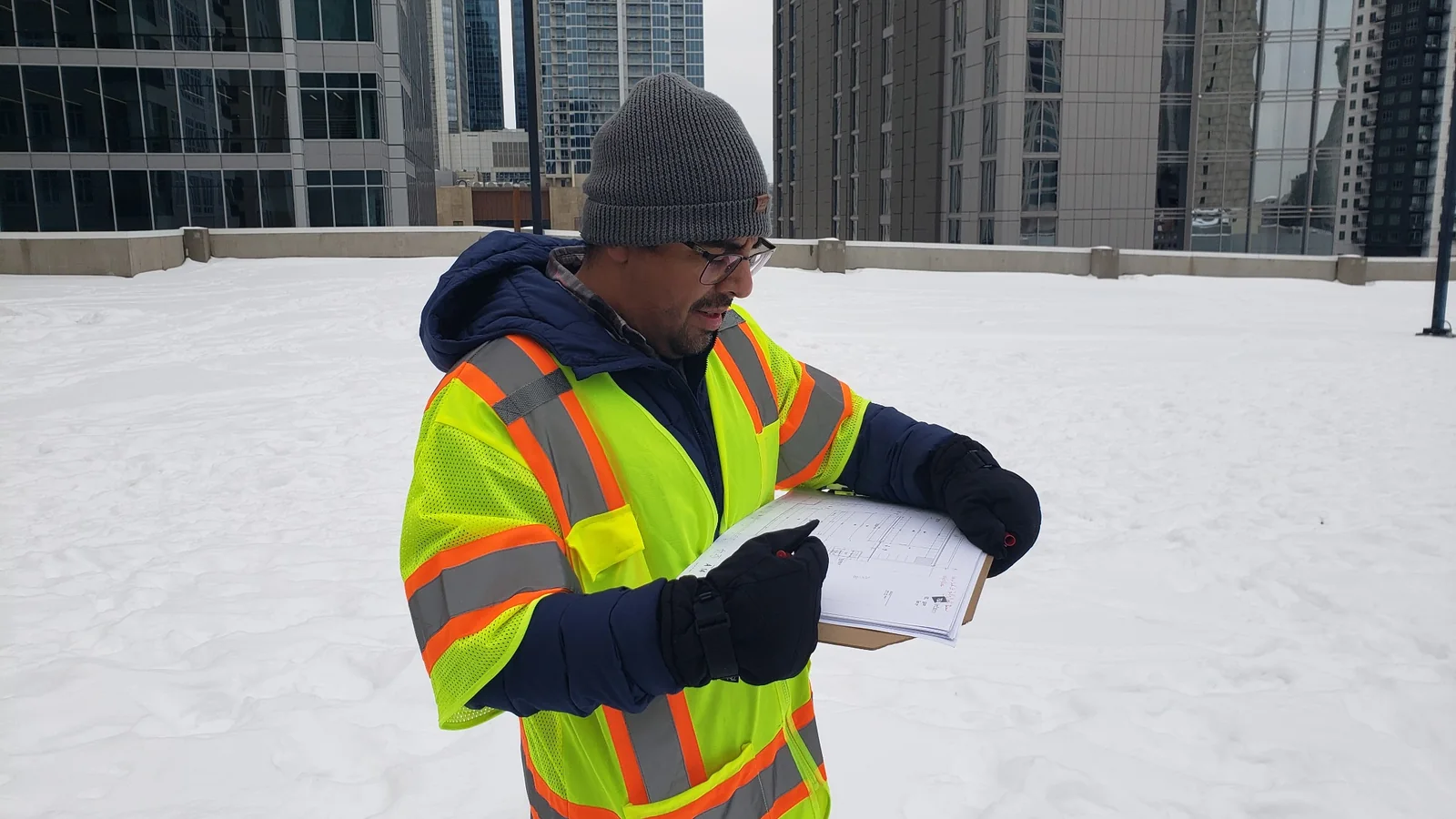
How Often Should a Parking Structure Be Inspected?
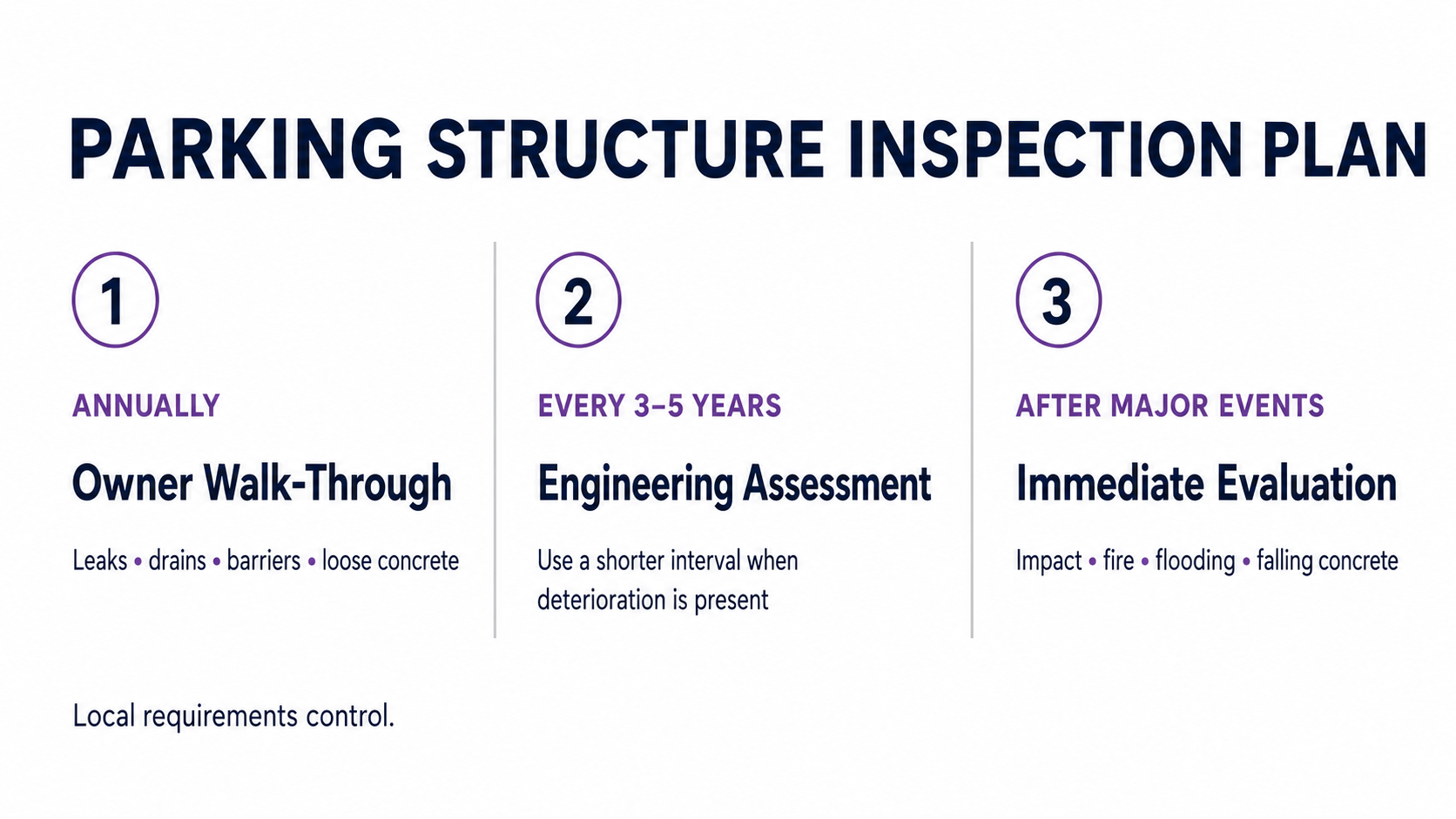
Where the local jurisdiction does not prescribe an inspection schedule, Preserve Engineers generally recommends the following:
- Newer or well-maintained structures: Complete a parking structure condition assessment every three to five years.
- Structures more than 20 years old or exposed to aggressive conditions: Consider an assessment approximately every three years.
- Structures with known deterioration or active repair needs: Complete assessments every one to three years, as recommended by the structural engineer.
- After a significant event: Complete a structural damage review after a vehicle impact, fire, flood, fallen concrete, suspected post-tensioning failure, or sudden change in cracking, movement, or deflection.
Facility personnel should also complete routine observations between professional assessments. Active leaks, blocked drains, loose concrete, impact damage, failed joints, damaged barriers, or visible changes in previously documented conditions should be reported promptly.
These intervals are planning guidelines, not universal code requirements. The appropriate frequency depends on the structural system, maintenance history, environmental exposure, current condition, and consequences of failure.
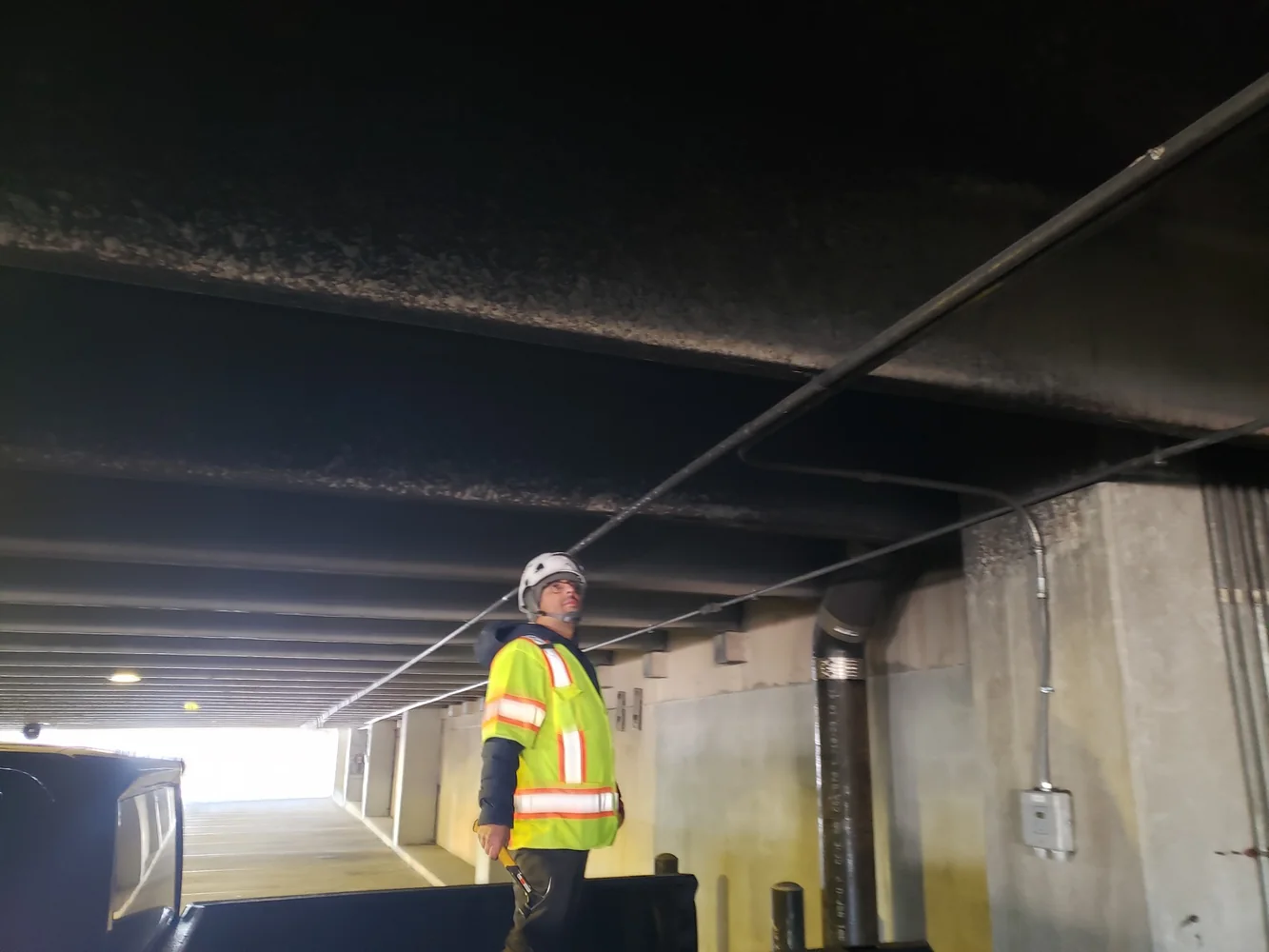
Where Are Parking Structure Inspections Required?
Most jurisdictions do not have parking-structure-specific periodic inspection laws. However, several states and municipalities have adopted formal programs:
- New York State: Parking structures must undergo condition assessments by or under the direct supervision of a New York State professional engineer. The interval between assessments may not exceed three years, although the local authority or engineer may require more frequent inspections.
- New York City: Parking structures must be inspected by a New York State professional engineer who is also a Qualified Parking Structure Inspector, or QPSI. Reports are currently filed on a six-year cycle. After the current cycle ends on January 1, 2028, inspections will generally be required every four years. To learn more click here
- Florida: Florida’s milestone-inspection law applies to residential condominium and cooperative buildings that are at least three habitable stories high. Inspections are generally required when the building reaches 30 years of age and every 10 years thereafter. Local authorities may establish a 25-year threshold based on local conditions. This is not a general inspection requirement for standalone commercial parking structures. To learn more click here
- New Jersey: Qualifying residential condominium and cooperative buildings with concrete, masonry, steel, heavy-timber, or hybrid structural systems must undergo periodic structural inspections. The law includes buildings with podium decks, which may contain parking. Subsequent inspections may not be spaced more than five years apart. The law does not apply to every standalone commercial parking structure.
- Minneapolis: Parking structures require annual on-site inspections by a qualified civil or structural engineer. More extensive destructive or nondestructive testing is generally required every third year as part of the operating-certificate process. To learn more click here
- Ohio Cities: Several Ohio municipalities have adopted parking-structure-specific inspection requirements. Beachwood generally requires inspections every two years, while Cleveland, Cleveland Heights, and Lakewood require inspections every five years. The inspections must be performed by qualified architects or engineers in accordance with each city’s requirements.
- Kansas City, Missouri: Structures containing parking areas with occupiable space above must be inspected by a Missouri-licensed professional engineer during the structure’s 15th year and every five years thereafter. This requirement does not apply to every standalone parking structure.
What Does a Professional Condition Assessment Include?
A parking structure condition assessment should be tailored to the structural system and the owner’s objectives. A typical assessment includes:
- Review of available drawings, previous reports, repair documents, and maintenance records
- Visual review of slabs, beams, columns, walls, ramps, stairs, and structural connections
- Evaluation of concrete cracking, delamination, spalling, corrosion, and exposed reinforcement
- Review of post-tensioning systems, precast connections, or structural steel, as applicable
- Review of expansion joints, sealants, traffic coatings, drainage, and active water leakage
- Evaluation of vehicle barriers, guardrails, and other safety-related components
- Limited sounding, probes, or material testing when needed to define concealed deterioration
The final report should identify unsafe conditions, recommended repairs, maintenance needs, additional testing, a cost estimate, and items requiring continued monitoring. Repairs should be prioritized so the owner can distinguish immediate safety concerns from short-term maintenance and longer-term capital improvements.
Warning Signs That Should Not Wait
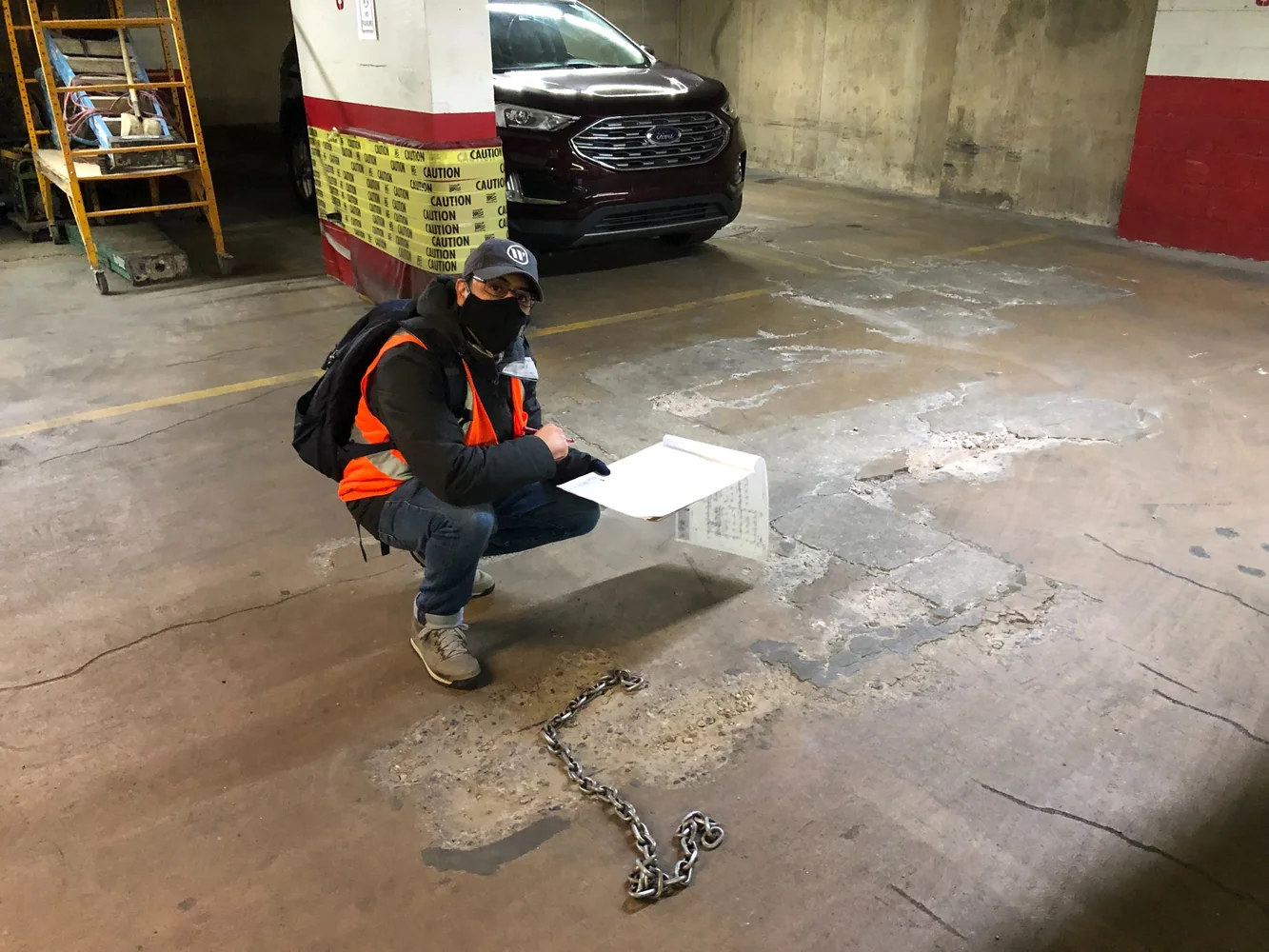
Some conditions should be evaluated immediately rather than waiting for the next scheduled assessment:- Loose, hanging, or fallen concrete
- Exposed reinforcing steel, prestressing strands
- New wide cracks or rapidly changing crack patterns
- Noticeable sagging, movement, or unusual vibration
- Vehicle impact to a column, wall, beam, barrier, or connection
- Broken or displaced precast connections
- Rust staining or leakage at post-tensioning anchorages
- Severely corroded steel or damaged vehicle barriers
Inspections Support Better Repair Planning
Regular inspections do more than identify unsafe conditions. They help owners locate water-entry paths, monitor known deterioration, plan repair programs, and establish realistic capital budgets. Addressing isolated leakage, failed joints, or localized concrete deterioration early is typically less disruptive and more cost-effective than waiting for the damage to spread. The goal is not simply to complete an inspection. The goal is to understand the structure’s condition, correct unsafe conditions, and develop a practical maintenance and repair program that extends its service life.How Preserve Engineers Can Help
Preserve Engineers provides parking structure condition assessments, code-required inspections, repair design, bidding assistance, construction administration, and long-term capital planning. Our team has experience with cast-in-place, post-tensioned, precast, steel, and mixed-system parking structures throughout the United States. Does your parking structure need an inspection?Preserve Engineers can help confirm applicable inspection requirements, evaluate existing conditions, prioritize repairs, and develop a practical maintenance program. Contact our team.
